BSI IT-Grundschutz Tool HITGuard
At the heart of the “BSI IT-Grundschutz ” compendium are the so-called IT-Grundschutz modules. Each module addresses a specific topic and the relevant security aspects. If the requirements of a module are not met, specific recommendations for corrective action are provided. Together with the BSI standards, the “ BSI IT-Grundschutz ” compendium forms a methodology for robust IT security management.
Our ISMS software, HITGuard, efficiently addresses the requirements of the BSI IT-Grundschutz compendium. HITGuard flexibly adapts to your individual needs. For example, many of our customers are interested in a combination of BSI IT-Grundschutz and ISO 27001. That’s no problem either. HITGuard guides and supports you from the very beginning through to the submission of your certification documents.
Is the topic new to you or do you need support in the implementation, e.g. to achieve ISO 27001 certification? Our competent team will be happy to help you!
and Betriebsführungsges.m.b.H
Future-Proof BSI Basic Protection with the " HITGuard " ISMS
BSI Basic Protection++ with a Focus on " HITGuard "
The BSI is currently further developing the IT-Grundschutz into Grundschutz++. TogetherSecure is itself a member of the working group and will prepare HITGuard to support Grundschutz++.
Important: The BSI Grundschutz++ is not yet final and is therefore subject to change. For production use, the established and stable guidelines of the existing IT-Grundschutz should therefore continue to be followed at this time.
With " HITGuard ," you can efficiently implement the current " BSI IT-Grundschutz " while also laying a solid foundation for systematically addressing future developments such as "Grundschutz++."
Highlights
- Licensed content of the BSI IT Baseline Protection Compendium
- Proposed measures for weaknesses found
- Easy determination of compliance coverage of Compendiums Chapters
- Annual update to the current Basic Protection Compendium
- Automatic migration of chapters that have already been reviewed to newer versions
- Preparing to Support BSI Grundschutz++ Following Finalization of the Methodology
- Audit-Ready Reports
TogetherSecure is an official licensee of the IT Baseline Protection Compendium.
Procedure for Standard Protection Using HITGuard
There are many points to consider when building a good ISMS. The IT baseline protection methodology can be seen as a guide to achieving the goal of a sustainable and economical ISMS without major detours.
The best way to see how HITGuard supports you through this process step by step is to look at the procedure recommended by the BSI for standard security measures (see diagram).
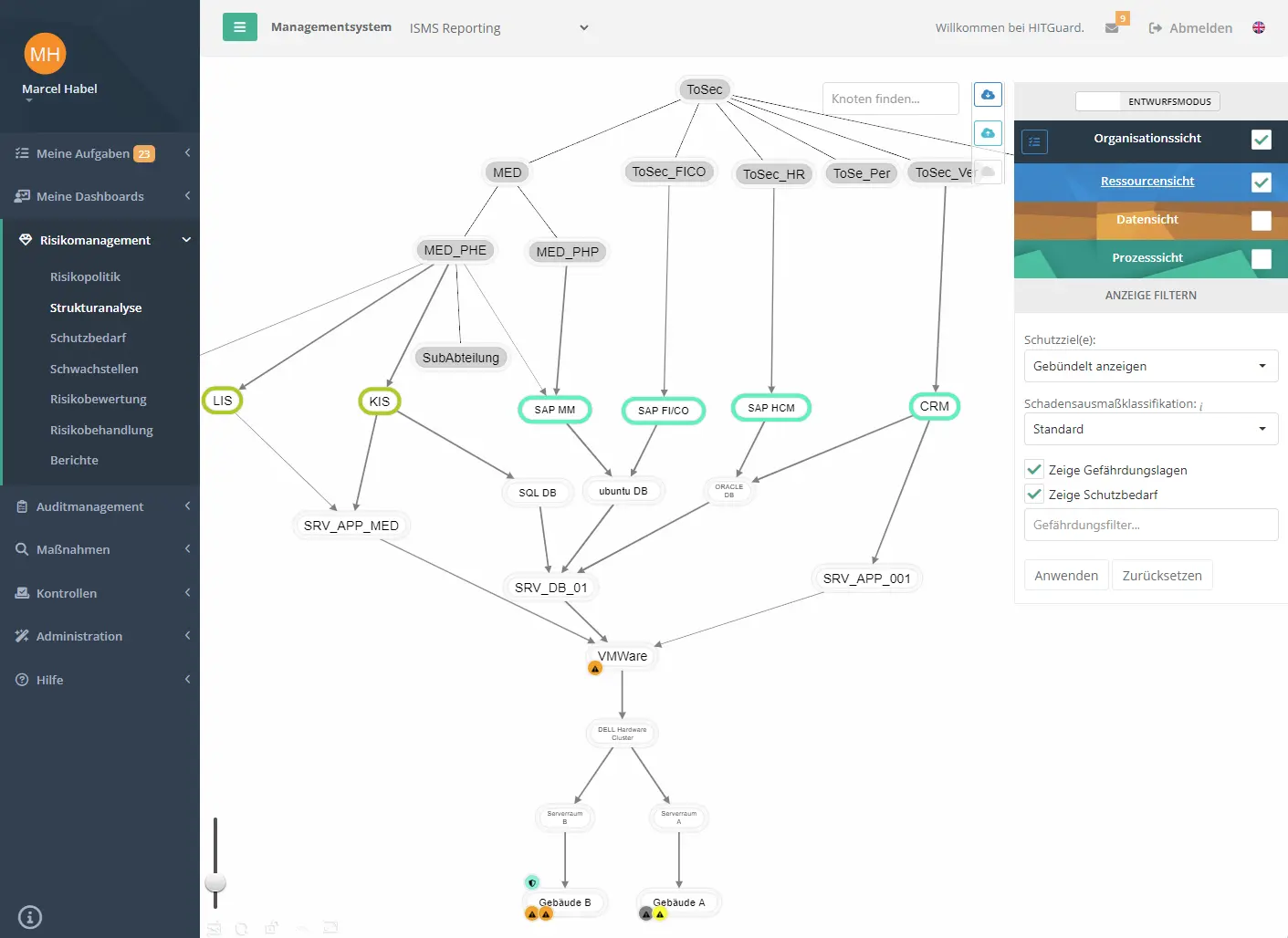
1 Assessment of the current situation by means of structural analysis
What are the important business processes in the company? What information is processed and stored in these business processes? What applications do you use to do this? Which IT systems are involved? These are questions that should be asked in the course of surveying the current situation.
"The aim of the structural analysis is to identify those objects and to describe their interaction for which protective measures must be defined in a security concept.
The aim of structural analysis is not to obtain a complete inventory of all the technical components used. Rather, you should sensibly group objects in all sub-surveys" (Source: BSI)
With the BSI Basic Protection software HITGuard , you can map your core applications, essential infrastructure services, and critical hardware or other high-priority assets in a graph and establish relationships between them. This enables you to perform protection-objective-specific analyses that, for example, provide insights into the interdependencies of processes and services and verify compliance with required recovery times.
2 Assessment of the need for protection
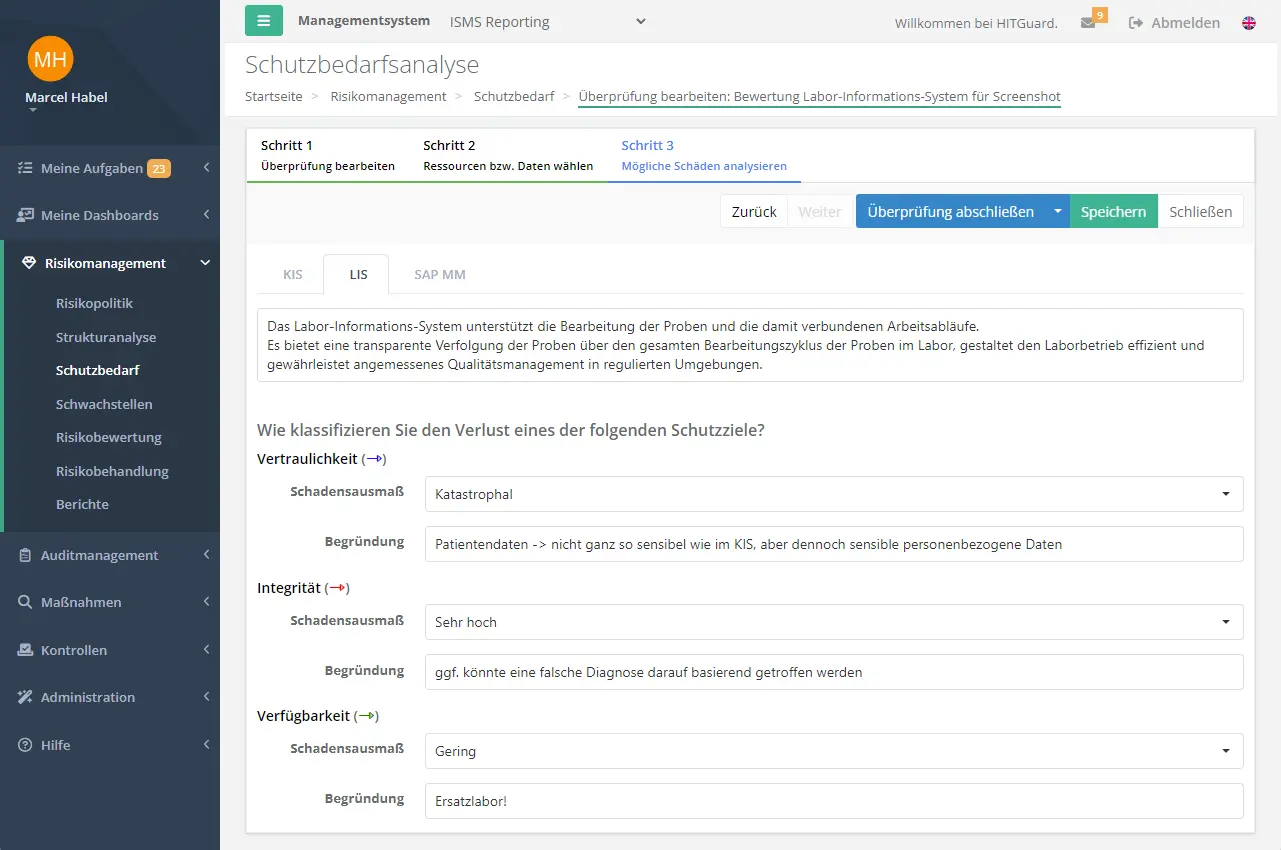
Once the relevant objects have been identified, the next step is to determine the need for protection. The question here is: What damage can occur if the basic values of confidentiality, integrity or availability are violated for an object?
Überlegen Sie hierzu zuerst mögliche Schadensszenarien (z.B. betriebliche Ausfallzeiten, Gesetzesverstöße, persönliche Unversehrtheit, Reputationsverlust). Anschließend bilden Sie mehrere Klassen je nach Größe des möglichen Schadens. Schreiben Sie dazu monetäre Grenzwerte fest, ab der ein Schaden für Sie z.B. überschaubar (< 10.000 €), beträchtlich (< 500.000 €) oder existenzgefährdend (> 500.000 €) ist. Diese Grenzwerte können je nach Unternehmensgröße sehr unterschiedlich sein.
The need for protection of an object basically depends on the need for protection of the business processes and information in which the object is involved. So start identifying the protection needs of your processes, applications, and information. The need for protection is then passed on to the applications, IT systems, network infrastructure, buildings, etc.
HITGuard supports you in many ways: in defining protection requirement classes in the risk policy, in the structured execution of analyses, and in the automatic inheritance of protection requirements
3 Modeling
During modeling, a test plan for the safety requirements of the objects is created based on the structural analysis and the determined protection needs .
At least one IT baseline protection module should be applied to each object of the security concept. To do this, you look at the building blocks of the IT baseline protection compendium individually and consider which objects they can be applied to. Chapter 2.2 of the Compendium provides assistance in this regard.
If no building block could be found for individual objects, a separate risk analysis must be carried out for these objects.
4 IT baseline protection check
Based on the created inspection plan, the objects are now checked. The requirements of the relevant IT baseline protection modules are reviewed question by question. It is determined whether existing security measures are sufficient or whether improvements are needed to achieve the necessary level of protection.
An IT baseline protection module includes basic requirements that must be met in any case, standard requirements for normal protection requirements and more far-reaching security measures for systems with increased protection requirements.
HITGuard provides the content of the " BSI IT-Grundschutz " compendium in the formof structured questionnaires. This systematic approach identifies all necessary security measures. If vulnerabilities are detected, HITGuard offers you appropriate recommendations for mitigating or resolving them.
The results of the checks must be able to be verified later by third parties (e.g. auditors). No problem with our BSI baseline protection software – you receive up-to-date documentation at the click of a mouse.
The IT-Grundschutz Compendium is continuously updated as technology evolves. It is therefore necessary to regularly verify whether the security measures in place are still sufficient. To do this, you can use HITGuard to reassess the relevant items. The system will display any changed requirements. For the remaining sections, you can simply adopt the existing answers and justifications. This significantly reduces your workload.
IT-Grundschutz continues to evolve. We are also keeping an eye on the new Grundschutz++ initiative. HITGuard will support this further development in the future. Since Grundschutz++ is not yet finalized and its content may still change, we currently recommend continuing to follow the established IT-Grundschutz Compendium for production implementations.
5 Risk analysis
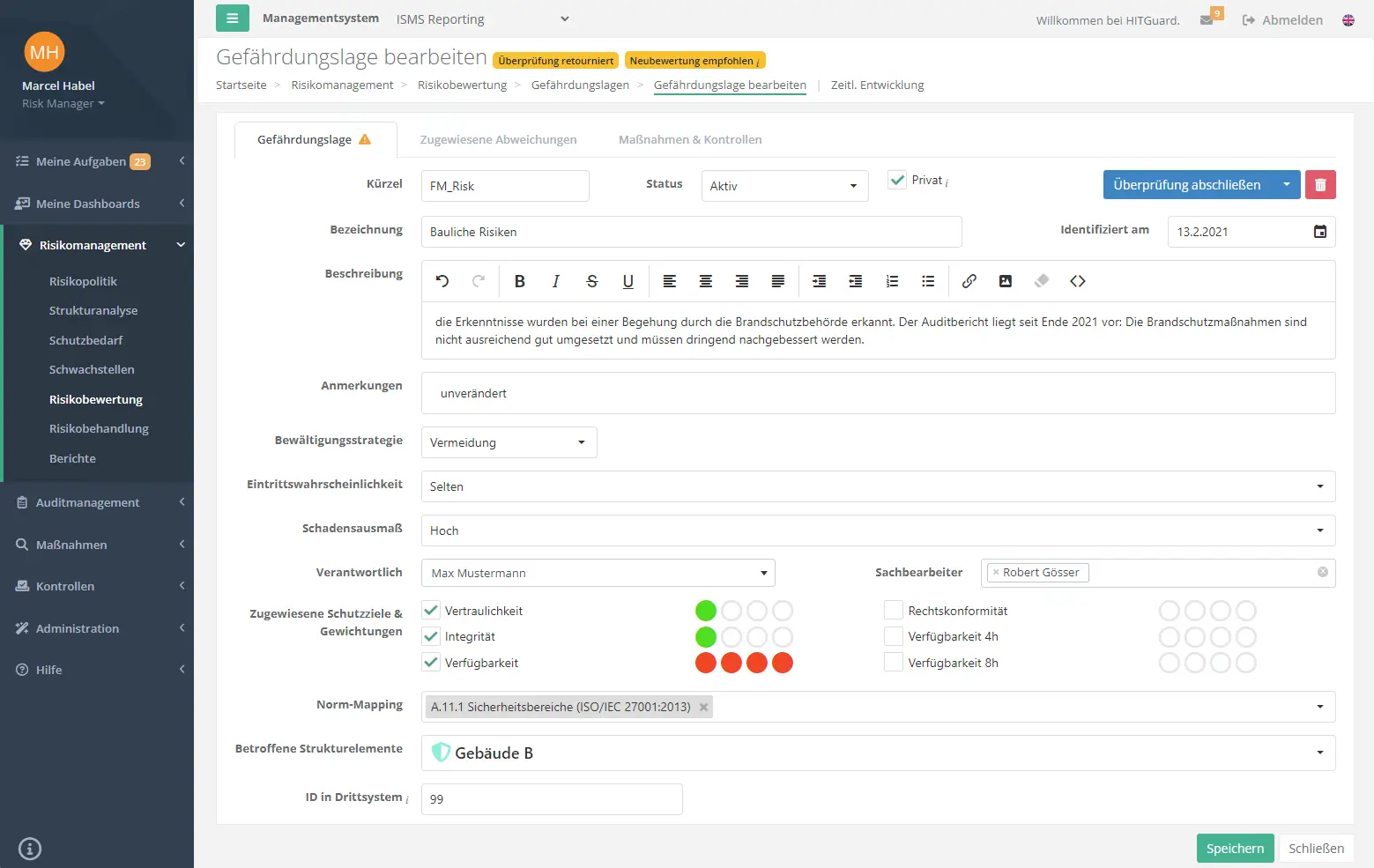
In the next step, identified vulnerabilities are categorized as risks. Vulnerabilities that are thematically related are grouped together. To help you identify potential risks, the IT-Grundschutz Compendium provides a list of 47 threats, which you can find at HITGuard .
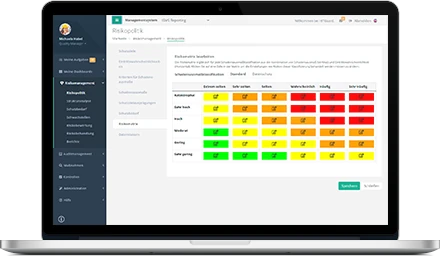
Then each risk must be assessed. The magnitude of the risk is determined by its probability of occurrence and the extent of damage to be expected in the event of occurrence. You define the categories you use to describe the probability of occurrence and the extent of damage in the risk policy.
Based on the risk assessment, decisions can then be made regarding how to address the risks. The risk matrix helps classify and prioritize the risks. If risk miti measures s are implemented later, the matrix can be used to illustrate their impact on the risk.
6 Implementation of the measures
In most cases, IT baseline protection checks and risk analyses lead to a number of deficits that subsequently need to be remedied. Be it a lack of security measures, a lack of security technology, organizational weaknesses or the like.
The BSI Basic Security Tool ( HITGuard ) helps you plan, prioritize, and implement measures to close gaps in your security strategy:
- Create " measures " based on recommendations from the IT-Grundschutz Compendium.
- Prioritize the measures based on the associated risk.
- Plan the implementation depending on the scope of measure.
- Assign the measures to the responsible individuals in the respective departments and have them update you on progress at definable intervals.
Finally, create controls use them, for example, to regularly check compliance with policies or the patch status of an IT system in the form of recurring tasks.
You can handle all of this easily and efficiently with the workflow-based Internal Control System (ICS) from HITGuard.
As mentioned earlier, this is not a one-time path. Plan to carry out the described process continuously and keep your security concept and your security organization up-to-date and secure at all times. Our competent experts will be happy to help you.
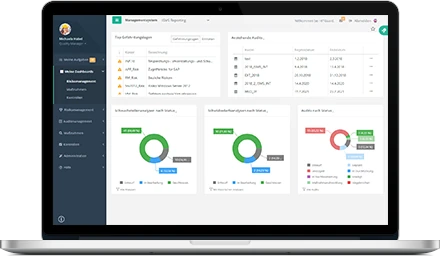
Assessment of the maturity levels of the chapters in the " BSI IT-Grundschutz " compendium. (Risk Dashboard)
Request a non-binding demo now
Learn how you can easily and efficiently implement the " BSI IT-Grundschutz " methodology using HITGuard
Success story
Emons Holding GmbH & Co. KG
Transport & Logistics Industry
3,650 employees
Emons Freight Forwarding & Logistics
Situation: As an international logistics company, Emons is particularly committed to protecting the critical information assets that form the foundation of successful customer services.
Goal: Implementation of a hybrid information security management system (ISMS) that is largely based on the international family of standards of ISO and the recommendations of the BSI's IT Baseline Protection Compendium.
Implementation: HITGuard offers the option of a hybrid implementation. The two information security standards can be used together in a coordinated manner. You do not have to choose one or the other; instead, you can use the available norms and standards, as well as the knowledge databases available at HITGuard , in combination.
Result: Emons was able to achieve the desired results quickly and in a resource-saving manner. Compliance with all internal and external requirements for information security and Data protection with the specifications and recommendations of the two standards is possible at the touch of a button.